“… always felt that the ground below him was charged with a sense of belonging.” Lapvona: A Novel, Ottessa Moshfegh
the place where [it] remains a little distanced and discursive, but to which we are unfathomably attached. Joe Jukes, Encountering Berlant part 1: Concepts otherwise.
Tina Campt on episode 8 of ICA Miami’s podcast; begins at 22:54. Listening as an act of attunement. Listening for quiet (not an absence/subtle presence) affective registers within an image, a work, an installation, a practice.
“Attend to that which is not always directly confronting us”
The installation merges the concept of Florida / Family rooms as a home’s casual, social hub for gathering, entertainment and play, with that of less-used living rooms that served as shrines for treasured family photos and heirlooms. Inspired/influenced by the artist’s friend and writer Noelle Barnes’ living room and the artist’s own memories of sunken living rooms of the 1970s, the artist considers the cultural phenomena of the living room as unlived, unoccupied, untouched spaces that children and guests were prohibited from using.
As an alternative, many people used ‘Florida/Family rooms’ to entertain company and watch television. Meanwhile, in the ‘unlived’ living rooms, many elders wrapped the furniture in protective plastic. For Mansa, these living rooms were treated as shrines–a space honoring one’s ancestors and those who have traveled beyond this plane. With this installation, the artist seeks to collapse the dichotomy between the ‘Living Room’ as shrine, and the ‘Florida/Family room’ in a way that creates ‘a room for the living’ as much as ‘a room for the dead’.
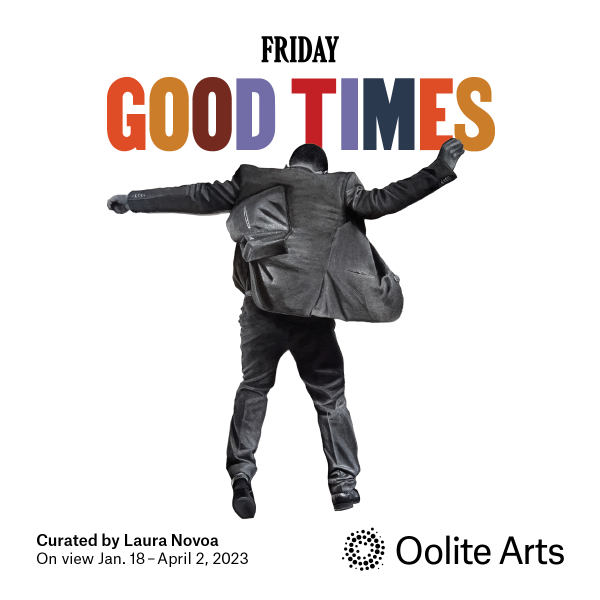
Chris Friday’s Good Times, curated by Laura Novoa, promises to engage quietly expressed modalities within the bold depicted.
[The works] prompt the viewer to consider more expansive notions of blackness and where communities – known and unknown – are given a space to dialogue, reflect, and celebrate.
Friday’s subjects – family, friends, colleagues – and the settings in which they exist, become mechanisms to unsettle traditional hierarchies and arrangements of power. In particular, she presents large-scale drawings of figures in acts of leisure – playing, dancing, resting – that refuse full exposure in a slight but noticeable turning away from the viewer. By placing them in the public realm (i.e. the gallery space), but limiting access to their interiority, Friday’s works inhabit a liminal space that is at once visible and hidden, silent and defiant.
Beauty will come to them
Where they stand.
[...]
Trees need not walk the earth
For beauty or for bread;
Beauty will come to them
In the rainbow—
The sunlight—
And the lilac-haunted rain
“It was necessary, she said, to do something to cure the multitude of its unreality. Her solution was fiction. She was making up their lives, their castes, their faiths, how many brothers and sisters they had, and what childhood games they had played, and sending the stories whispering through the streets into the ears that needed to hear them. She was writing the grand narrative of the city, creating its story now that she had created its life. Some of her stories came from her memories of lost Kampili, the slaughtered fathers and the burned mothers; she was trying to bring that place back to life in this place, to bring back the old dead in the newly living, but memory wasn’t enough, there were too many lives to enliven, and so imagination had to take over from the point at which memory failed.”
A sackful of seeds, Salman Rushdie, New Yorker, December 12, 2022 issue.
When the dead return
they will come to you in dream
and in waking, will be the bird
knocking, knocking against glass, seeking
a way in, will masquerade
as the wind
Memory is the seamstress, and a capricious one at that. Memory runs her needle in and out, up and down, hither and thither. We know not what comes next, or what follows after. Thus, the most ordinary movement in the world, such as sitting down at a table and pulling the inkstand towards one, may agitate a thousand odd, disconnected fragments, now bright, now dim, hanging and bobbing and dipping and flaunting, like the underlinen of a family of fourteen on a line in a gale of wind
I have sewn the bits that I have, and those I can recall, as new ones will not be formed, into a thing that can renew, give strength, and maybe offer wisdom and joy.
Related : Gabriela GamboaNew Topographies: 25.7617° N, 80.1918 W° at Bakehouse curated by Laura Novoa.
“an unending search for a sense of belonging and place exacerbated by the challenges of exile.
[…]
Gamboa reconstructs a “personal mythology,” an exercise in remembering a place that no longer exists as it once did. She does so by expanding upon the notion of geography, not only as it pertains to the physicality of a landscape (i.e. its topography), but also how it is affected by human intervention.”