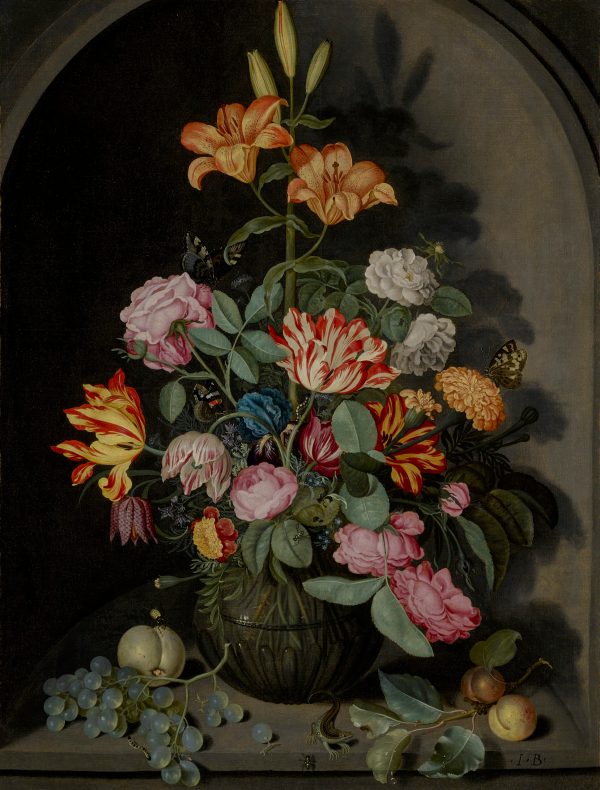
David Castillo presents The Floral Impulse, an exhibition of works by over 25 artists organized by Xaviera Simmons in curatorial collaboration with David Castillo. Simmons included artists who naturally intersect with her own practice in concept and/or aesthetics. In painting, sculpture, photography, assemblage, and video, the exhibition contemplates the long history of the floral still life genre and the mythologies, symbolisms, and historical references encoded within pictorial representations of flowers.
The exhibition features work by Michael Adno, Rachael Anderson, Johannes Bosschaert, Se Jong Cho, Petra Cortright, Alejandro Garcia Contreras, Amber Cowan, Maria de los Angeles Rodriguez Jimenez, Timo Fahler, Naomi Fisher, Adler Guerrier, Daniel Gibson, Lyle Ashton Harris, Matthew Day Jackson, Austin Lee, Kalup Linzy, Grant Levy Lucero, Pepe Mar, Jillian Mayer, Nabeeha Mohamed, Cruz Ortiz, Rachel Rose, Devan Shimoyama, Xaviera Simmons, Shinique Smith, Nadir Souirgi, Su Su, and Yesiyu Zhao.
From humanity’s earliest recorded histories, the flower has served an intimate, sensual, and visceral role as a subject of allegorical meaning. Florals have long ornamented and bloomed across fundamental aspects of life as expressions of mourning, growth, remembrance, love, beauty, ritual, and resistance. In the inverse, flowers have at times been coded as shallow tokens of adornment or decay. Their uses and representations span time, place, and culture, in many ways forming a familiar and unifying grammar that connects human experience across its myriad conditions.
The floral measures time and marks history. The fleeting nature of life and its simple pleasures emerged among the moralizing themes imbued into flowers—as subject and symbol—during the late Renaissance, when the still life genre flourished in Northern Europe. Artists of the period depicted flowers in all their states, from bud to bloom to their inevitable wilting. These memento mori and vanitas paintings emphasized life’s transience, fragility, and frivolity in the grander scheme, reminding the viewer of their own impending mortality: They, like the flower, will one day wilt. Two centuries later in the Victorian era, interest soared in floriography, the symbolic language of flowers, allowing friends and lovers to communicate, through coded floral arrangements, the desires their society would not allow them to voice aloud. The Impressionists later took to flowers en plein air, capturing the beauty, immediacy, and ever-changing conditions of the natural world. And from Modernism to the contemporary, florals have been portrayed and iconized across a multitude of styles and movements that reinterpret their shapes, forms, colors, and significations.
The Floral Impulse identifies the flower across these diverse and distinct dimensions. Finding their contours across the practices of 28 artists, the florals represented in this exhibition pulse with the potentials of their iconographic predecessors.
Across three photographs, Michael Adno documents native and invasive flora found across the state of Florida.
Rachael Anderson recalls the history of the still life genre in which flowers depicted drooping and decaying mirror the fragile and temporal nature of life.
Johannes Bosschaert, the Northern Renaissance painter, came from a family of storied artists whose floral still lifes carried symbolic and religious meaning.
Se Jong Cho’s paintings depict close-ups of floral dissections that give an open view into the anatomy of a flower.
Petra Cortright reinterprets the floral still life into the contemporary language of digitality.
Amber Cowan depicts a fantastical and loaded floral scene across an intricately detailed glass assemblage.
Timo Fahler’s works play out scenes embedded with personal memory of family and life in the Southwest where he grew up; flowers in his work evoke the memory of his grandmother, who loved to garden.
Naomi Fisher’s work portrays a bird with its eggs nestled among blooming plants; these symbols each represent aspects of nature that cycle through seasons of birth.
Alejandro Garcia Contreras inverts the relationship between vase and flower in his ceramic sculpture; it bears flowers on its surface rather than within.
Daniel Gibson paints vivid, quasi-autobiographical scenes where flowers and other symbols of resilience, freedom, and celebration speak to his experiences of migrating to America from Mexico at a young age.
Adler Guerrier approaches his practice as a flâneur and cultural cartographer, exploring the flora dotting the urban environment as a motif towards adapted visions of Utopia.
Lyle Ashton Harris builds networks of memory in collages where personal photographs taken by the artist are pinned to a wall alongside ones—among them flowers, artworks, and portraits—taken from books, newspapers, and other media.
Matthew Day Jackson works in direct conversation with Northern Renaissance painters in works where he recreates their floral still lifes in mixed media.
Combining digital tools and traditional techniques, Austin Lee’s paintings convey the affective dimensions of the flower.
Grant Levy Lucero’s ceramic diptych interprets the flower across two treatments: In an amphora with surface overgrown with lilies, and in a second vessel painted with the branding of Miracle-Gro Plant Food.
Kalup Linzy unravels the family tree from which his pantheon of drag personalities originate, depicting them in a landscape as flowers.
In his highly layered visual language, Pepe Mar incorporates a floral print by the 16th century Italian botanist Giovanni Baptista Ferrari into an assemblage work where found objects link past with present.
Jillian Mayer’s sculptures embed floral drawings within multi-colored panes of glass, drawing connections with the legacy of stained glass.
Nabeeha Mohamed’s florid painting challenges questions of class privilege by depicting a beautiful object in crude detail and brash colors.
In a highly stylized work where skulls and roses surround a central figure in a cowboy hat, Cruz Ortiz’s painting redefines themes of memento mori and vanitas paintings in the context of South Texas and the histories and politics that inform life on the Texas-Mexico border.
Maria de los Angeles Rodriguez Jimenez renders a swirling vortex of eyes and hair that together echo an image of a pistil and petals.
Rachel Rose’s work depicts clipped scenes of collage in which the flora assembled is made from found and scavenged photographs taken from children’s books.
Devan Shimoyama’s sculpture, a memento mori, depicts a swing adorned with flowers hanging from a heavy chain.
Across subtle and sparse compositions, Xaviera Simmons’ elegant photographs of floral bouquets are loaded with associations to artists across centuries who have used the floral as metaphor.
Shinique Smith’s collages incorporate vintage fabrics, embroidered appliques, and swirling strokes of black ink that together form bouquets of association to personal memories and art historical references.
A surreal scene unfolds in Nadir Souirgi’s piece, a painting of Post-Impressionist Paul Gauguin experiencing a hallucination where he sees himself in a haunting, blooming landscape.
In a process whereby the artist paints with the canvas hanging overhead, Su Su’s still life of a vase, flower, and hundred-dollar bill—recalling vanitas painting—drips outward, reaching towards the viewer.
On a canvas that evokes the shape of flower petals, Yesiyu Zhao’s painting depicts a person fiercely wielding a weapon.