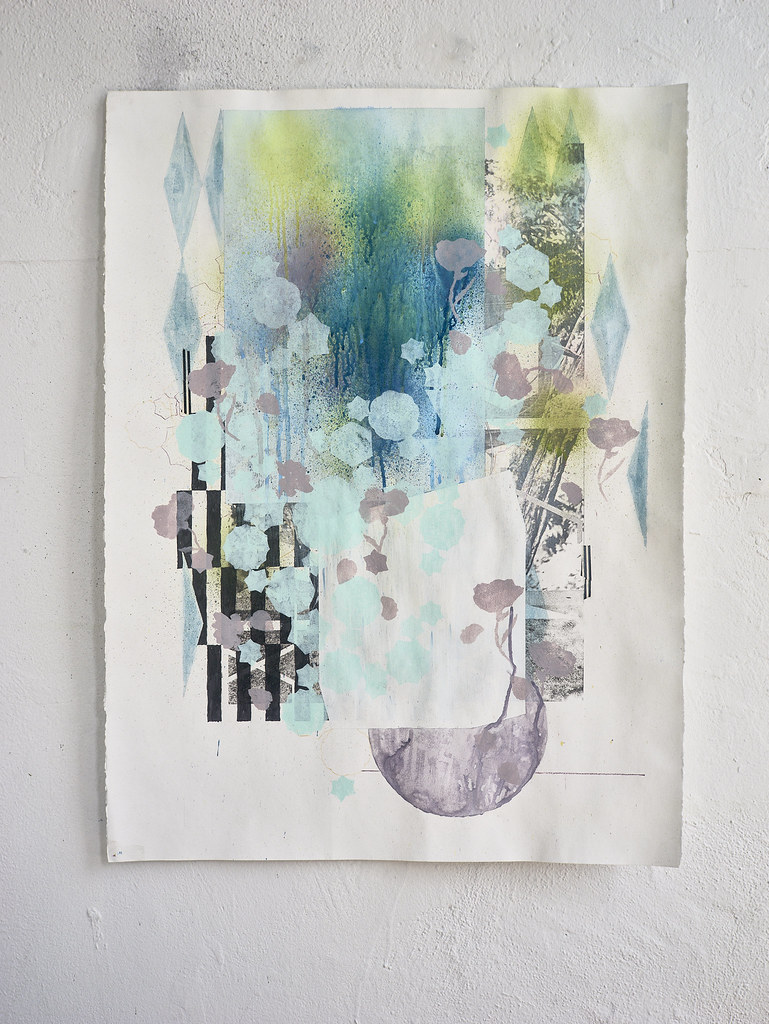
Untitled (sourced from the blck indices; formed and regulated; meandering and purposeful) 2026, Graphite, colored pencil, ink, acrylic, gesso, watercolor, gouache, tape, and solvent transfer on paper, 30” x 22.25”
How do you represent the divine and the central miracles of Christianity? Divine Presence explores this question through the captivating world of marble representations in Late Gothic and Early Renaissance art. (Hatje Cantz Verlag)
“GG [Gary Garrels]: In 2008 we approached Kerry James Marshall about making new works for those walls. I had done a show here with Kerry James in the 1990s, so we already had a wonderful relationship of long standing. He decided he wanted to do something in dialogue with San Francisco’s venerable Mission mural tradition. He began discussions with Precita Eyes and came up with a plan to create views of the plantations of George Washington (Mount Vernon) and Thomas Jefferson (Monticello), but with black figures inserted. The intent was to point to the presence of black Americans on the plantations, while highlighting their absence from public history. The murals were fabulous.”
Spinning through space for eons, our earth—oceans, rivers, mountains, glaciers, tigers, parrots, redwoods— evolving wonders.
And our vast array, generations of humans—all shapes, colors, languages.
Can I be the only me?
Our earth: so much beauty, hate, goodness, greed.
“Study. Cool the climate,” advises my teacher. “Grow peace.”
    Can I be the only me,
                  become all my unique complexity?
“A soldier waits until he’s called—then moves ass and balls up, over, tearing twigs and crushed faces, swinging his bayonet like a pitchfork and thinking anything’s better than a trench, ratshit and the tender hairs of chickweed. A soldier is smoke waiting for wind; he’s a long corridor clanging to the back of a house where a child sings in its ruined nursery… and Beauty is the gleam of my eye on this gunstock and my spit drying on the blade of this knife before it warms itself in the gut of a Kraut. Mother, forgive me. Hear the leaves? I am already memory.”
"Give me a place to stand," Archimedes said,
"and I can move the world." Paradoxical, clever,
his remark which first explained the use of the lever
was an academic joke. But if that dead

sage could return to life, he would find a clear
demonstration of his idea, which is not
pure theory after all. That putative spot
exists in the love I feel for you, my dear.

What could be more immovable or stronger?
What becomes more and more secure, the longer
it is battered by inconstancy and the stress

we find in our lives? Here is that fine fixed point
from which to move a world that is out of joint,
as he could have done, had he known a love like this.
“Yáng Shu?ng-z?’s Taiwan Travelogue has won the 2026 International Booker Prize.” “It succeeds as both a romance and an incisive postcolonial novel.” (NPR)
In Xanadu did Kubla Khan A stately pleasure dome decree: Where Alph, the sacred river, ran Through caverns measureless to man Down to a sunless sea. So twice five miles of fertile ground With walls and towers were girdled round: And there were gardens bright with sinuous rills, Where blossomed many an incense-bearing tree; And here were forests ancient as the hills, Enfolding sunny spots of greenery
As she laughed I was aware of becoming involved in her laughter and being part of it, until her teeth were only accidental stars with a talent for squad-drill. I was drawn in by short gasps, inhaled at each momentary recovery, lost finally in the dark caverns of her throat, bruised by the ripple of unseen muscles. An elderly waiter with trembling hands was hurriedly spreading a pink and white checked cloth over the rusty green iron table, saying: ‘If the lady and gentleman wish to take their tea in the garden, if the lady and gentleman wish to take their tea in the garden …’ I decided that if the shaking of her breasts could be stopped, some of the fragments of the afternoon might be collected, and I concentrated my attention with careful subtlety to this end.
Under the Bridge. 12425 NE 13th Ave, North Miami, 33161.
The kinds of proximity that matter here are made by practices of attention not defined by dissensus or agonism but technically, by atmosphere-generating juxtaposition. This proximity dilutes what we called structural by shifting the force of the normative infrastructures from the state and commodity capitalism into the ordinary that also includes local plural intimacies and the associations that make life sticky and interesting.