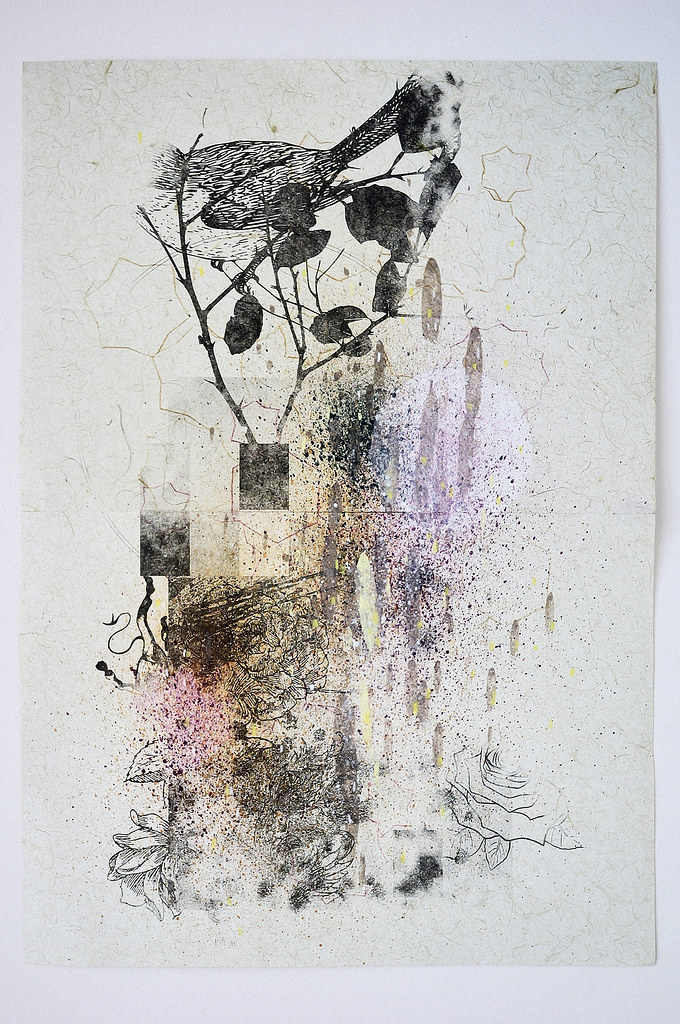
in which we might be both singular and plural, both fully

Kushner often cites DeLillo as an influence, but Creation Lake most clearly bears the imprint of a handful of European writers, including the Italian novelist and poet Nanni Balestrini and the French crime novelist Jean-Patrick Manchette. The first chapter of Manchette’s 1976 novel Le Petit Bleu de la côte ouest (Three to Kill) begins, “And sometimes what used to happen was what is happening now,” before launching into a description of Manchette’s protagonist, Georges Gerfaut, a middle-class nobody caught up in murder:

“The reason why Georges is barreling along the outer ring road, with diminished reflexes, listening to this particular music, must be sought first and foremost in the position occupied by Georges in the social relations of production. The fact that Georges has killed at least two men in the course of the last year is not germane. What is happening now used to happen from time to time in the past.”

In her introduction to a 2016 English translation of Balestrini’s We Want Everything, an electric account of Italy’s “Hot Autumn” of workers’ strikes in 1969, Kushner observed that his narrators—who are often nameless—“are always one person speaking anonymously as a type.” Their “voices,” she continues,

“have all the specificity of an individual—a set of attitudes, moods, prejudices, back stories, but they each speak in a way that exemplifies what life was like for a person such as them, in a moment when there were many like them.”

Paradoxically, this anonymity works against the sense of alienation Lukács described—at least in the domain of literature. If capitalism creates a world in which human beings are violently atomized, cut off from one another by the daily demands of wage labor and the barriers of class society, the character who speaks at once for himself and for everyone like him represents the possibility of a world in which we might be both singular and plural, both fully, freely ourselves and part of a multitude of interdependent, mutually supportive lives.

The Secret Agent, Anahid Nersessian
Reviewed: Creation Lake by Rachel Kushner

Paterson, Passaic, plicated

His [Robert Smithson] break from painting would eventually lead him to construct—with the help of bulldozers and pilots and his wife and collaborator, the late Nancy Holt—“Spiral Jetty,” his best-known project, completed in 1970. It’sa fifteen-hundred-foot-long, fifteen-foot-wide spiral of stone that extends out into the Great Salt Lake, in Utah. According to the catalogue for an exhibition at the Montclair Art Museum, entitled “Robert Smithson’s New Jersey,” it was Smithson’s visit to his pediatrician that helped steer him toward that new work, and began a new chapter for American landscape art. His pediatrician was William Carlos Williams.

[…]

When Smithson arrived at Williams’s home, the older poet had recently suffered several strokes but had just published the final volume of “Paterson,” his epic set in and around the Great Falls of the Passaic, the raging seventy-seven-foot-high cataract in Paterson. In an essay written by the exhibition’s guest curator, Phyllis Tuchman, we learn that Smithson looked at paintings by Marsden Hartley, Charles Demuth, and Ben Shahn in Williams’s home, and that, according to Smithson’s friends, the artist took to heart Williams’s axiom “No ideas, but in things.” In 1972, shortly before Smithson died, he would describe “The Monuments of Passaic” [an essay that ran in Artforum in December of 1967] in terms of “Paterson.” “In a way, this article that I wrote on Passaic could be conceived of as a kind of appendix to William Carlos William’s poem Paterson,” he said.

The Source of Robert Smithson’s Spiral
Robert Sullivan, The New Yorker, June 18, 2014

AG2023-Document-Folds013023-page005-007

AG2024_1122725a or how many selves are you going to be

AG2024_1122725a

INTERVIEWER

What about the act of creating something from scratch? Is that experience similarly spatial?

CARSON

I think about it as something that arrives in the mind, and then gets dealt with if it’s interesting. It’s more like a following of something, like a fox runs across your backyard and you decide to follow it and see if you can get to where the fox lives. It’s just following a track.

[…]

INTERVIEWER

I worry that—in America at least—the act of critical thinking is being devalued from a cultural perspective. Do you notice that as a thinker or teacher?

CARSON

That’s part of the thing that made me start thinking about hesitation. The last few years I was teaching, I was teaching ancient Greek part of the time and writing part of the time. And the ancient Greek method when I was in school was to look at the ancient Greek text and locate the words that are unknown and look them up in a lexicon. And then find out what it means and write it down. Looking up things in a lexicon is a process that takes time. And it has an interval in it of something like reverie, something like suspended thought because it’s not no thought because you have a question about a word and you attain that as you go through the pages looking for the right definition, but you’re not arrived yet at the thought. It’s a different kind of time, and a different kind of mentality than you have anywhere else in the day. It’s very valuable, because things happen in your thinking and in your feeling about the words in that interval. I call that a hesitation.

Nowadays people have the whole text on their computer, they come to a word they don’t know, they hit a button and instantly the word is supplied to them by whatever lexicon has been loaded into the computer. Usually the computer chooses the meaning of the word relevant to the passage and gives that, so you don’t even get the history of the word and a chance to float around among its possible other senses.

That interval being lost makes a whole difference to how you regard languages. It rests your brain on the way to thinking because you’re not quite thinking yet. It’s an absent presence in a way, but it’s not the cloud of unknowing that mystics talk about when they say that God is nothing and you have to say nothing about God because saying something about God makes God particular and limited. It’s not that—it’s on the way to knowing, so it’s suspended in a sort of trust. I regret the loss of that.

Anne Carson in The Paris Review


Zadie Smith on brut.media
“people understand themselves in relation to other people” “how many selves are you going to be … it’s wild” “people are like this … they are not just what they say they are … they’re these other things as well” ” I use these emotions to play these people”

And off they went

And off they went, emitting a perfect major triad via fart-noises with their mouths, sending down, as if in farewell, a rain of celebratory hats: flared Tops, Turkish house caps; kepis of various colors; a flower-bedecked Straw, falling rather more slowly than the rest, a lovely thing, redolent of summer.

[…]

a soldierly fixity of mind

[…]

only utter hopelessness will lead him to do what he must.

George Saunders, Lincoln in the Bardo

The Diplomat. Set in Barcelona.

Alexander Calder. Masi Lugano. Sphere Pierced by Cylinders, 1939 (at Pulitzer, 2015.) S and Star, 1941.

AG2024_1122723a or I am what I was and more

AG2024_1122723a

Say what you will, and scratch my heart to find 
The roots of last year’s roses in my breast; 
I am as surely riper in my mind 
As if the fruit stood in the stalls confessed. 
Laugh at the unshed leaf, say what you will, 
Call me in all things what I was before, 
A flutterer in the wind, a woman still; 
I tell you I am what I was and more.

My branches weigh me down, frost cleans the air. 
My sky is black with small birds bearing south; 
Say what you will, confuse me with fine care, 
Put by my word as but an April truth,— 
Autumn is no less on me that a rose 
Hugs the brown bough and sighs before it goes.

Say what you will, and scratch my heart to find, Edna St. Vincent Millay (1922)