
Category: language
-
AG2021_2050082a or presentness

KT – “Love takes off the masks that we fear we cannot live without and know we cannot live within.” And then James Baldwin says, “I use the word ‘love’ here not merely in the personal sense, but as a state of being, or a state of grace, not in the infantile American sense of being made happy, but in the tough and universal sense of quest and daring and growth.”
SJ- So amazing. You hear James Baldwin, the son of a preacher. And for him, that love that he always saw and grasped for and had hope in — that he called that grace. And what grace grasps is the thing that it’s not just a given. It really is a gift, and it has political force. It’s quest. It’s daring. It’s exploration. And James Baldwin reminds us that if we give up that hope, that quest in love, then we’ve lost.
On Being with Krista Tippett
Serene Jones
Grace in a Fractured World
Original Air Date
December 5, 2019
Presentness is grace.
Michael Fried, “Art and Objecthood,” in Art and Objecthood: Essays and Reviews (Chicago: University of Chicago Press, 1998), pp. 148-72. Originally published in Artforum 5 (June 1967): pp. 12-23.“Michael Fried pushed the question of presence to the fore in his famous (perhaps infamous) essay “Art and Objecthood.”[2] Fried distinguishes between, on the one hand, the presentness of modernist art—art that defeats its own objecthood, that displays a conviction which avoids theatricality, that at every moment renews a claim upon the viewer; and, on the other, the presence of Minimalist, or what he called literalist, art—art that embraces (“hypostasizes”) its own objecthood, that is fundamentally theatrical, that includes the viewer in its situation and requires her for its completion.
[…] At the end of his essay, Fried seems to turn from creation to fall and the hint of redemption. He writes, “I want to call attention to the utter pervasiveness—the virtual universality—of the sensibility or mode of being that I have characterized as corrupted or perverted by theater. We are all literalists most of our lives. Presentness is grace.”[5] I read Fried here as claiming that we live in a world where objects are usually present to us simply as objects, and that modernist art offers something extraordinary: an object becoming more than an object, carrying with it the presentness that comes to us as “grace.”
Natalie Carnes, Presence, Presentness, and Grace: Reflections on Art and Theology with Michael Fried and Marina Abramovic, transpositions.co.uk.To avert one’s gaze from Piper is to refuse to hear the sound in her work of that quite specific objecthood that joins blackness and black performance. And the critique of Fried’s dismissal of objecthood and its complex, ambivalent grounding in Clement Greenberg’s in/famous assertion of the necessary optical purity of authentic modernist art is possible only by way of the exploration of that specifically black objecthood that it has been Piper’s project to inves-tigate. If, as Zora Neale Hurston suggests, the essence of the Negro is drama, theatricality, then perhaps this is how that theatricality works. (p.234)
Perhaps the real importance of the frame /support /boundary is that it divides the work from the milieu that defines and contains what Fried describes as our quotidian literalism. The parergon is, here, the condition of possibility of what Fried valorizes and hopes for: presentness as grace, presentness as opposed to presence. The literalist work /object is without or in denial of the parergon. The two relations to be thought, here, are lack and denial, parergon and milieu. (p.243)
Fred Moten, Resistance of the Object:Adrian Piper’s Theatricality, In the Break. -
AG2021_2050068a

[…] Inside the glass, the abstract
“The Empty Glass” from The Seven Ages by Louise Glück. Copyright © 2001 by Louise Glück.
tide of fortune turned
from high to low overnight.Whirling in the dark universe,
alone, afraid, unable to influence fate—What do we have really?
Sad tricks with ladders and shoes,
tricks with salt, impurely motivated recurring
attempts to build character.
What do we have to appease the great forces? -
Rita Dove reading her poems in the Montpelier Room, May 4, 1995
Dove, Rita, Gertrude Clarke Whittall Poetry And Literature Fund, and Archive Of Recorded Poetry And Literature. Rita Dove reading her poems in the Montpelier Room, May 4. 1995. Audio. Retrieved from the Library of Congress, <www.loc.gov/item/95770167/>.
Contents :
From Mother love : Heroes ; Persephone, falling ; The narcissus flower ; Statistic : the witness ; Mother Love ; Breakfast of champions ; Persehpone in hell (section I) ; Wiederkehr ; The Bistro Styx ; Demeter mourning ; Exit ; Afield ; Lost brilliance ; Demeter, waiting ; Lamentations ; Used ; Missing ; Demeter’s prayer to Hades ; Her island — Evening primrose — Incarnation in Phoenix — The first book — Vacation.
A flower in a weedy field
make it a poppy. You pick it.
Because it begins to wiltyou run to the nearest house
to ask for a jar of water.
The woman on the porch startsscreaming: you’ve picked the last poppy
in her miserable garden, the one
that gives her the strength every morningto rise! It’s too late for apologies
though you go through the motions, offering
trinkets and a juicy spot in the written historyshe wouldn’t live to read, anyway
So you strike her, she hits
her head on a white boulder,and there’s nothing to be done
but break the stone into gravel
to prop up the flower in the stolen jaryou have to take along,
because you’re a fugitive now
and you can’t leave clues.Although the story’s starting to unravel,
the villagers stirring as your heart
pounds into your throat. O whydid you pick that idiot flower?
Because it was the last one
and you knewit was going to die.
Related : Louise Glück’s Persephone the Wanderer
-
Between Islands and Peninsulas
Terremoto‘s blog–Amanda Linares presents Between Islands and Peninsulas at Bakehouse Art Complex.

Artist book Todo Sigue Igual (detail); photo by Pedro Wazzan, 2021 […] the viewer is taken on their own journey, mirroring the one Linares represents in Between Islands and Peninsulas, an immigrant’s story that transports you over time, space, and destinations.
Linares’ varied use of materials allows her to create works that are simultaneously delicate yet durable. She seeks to capture the contradictions of the human condition through materiality. In the artist books Todo Sigue Igual, Agua Salada, and Alternative Realities, she uses seemingly disparate mediums to convey the coexistence of the contradictory emotions and ideas. The artist books, constructed geographies of text and images, evoke the feelings of nostalgia, displacement, and disorientation Linares experienced during her own diaspora.
Laura Novoa -
TIS03
TIS03 is twelve books by twelve artists, sold both as a box set and as individual titles.
Tim Carpenter / A month of Sundays
Adler Guerrier / Sheltering in, so we can begin again
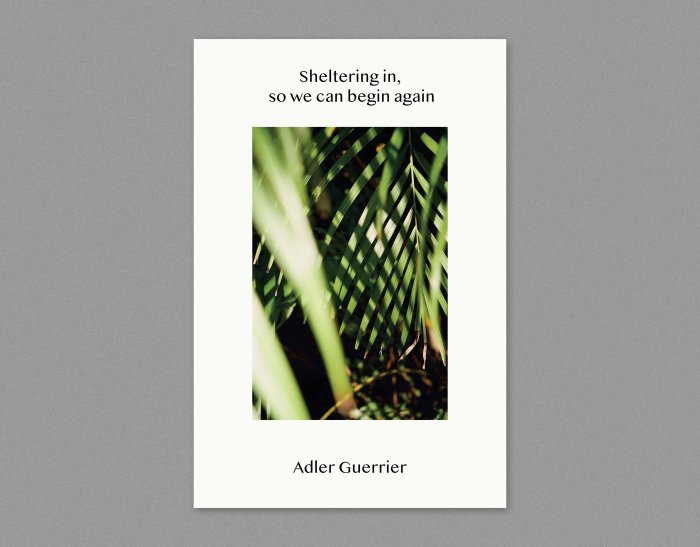
16cm x 24cm
softcover
48 pages
ISBN 978-1-943146-23-9Will Matsuda / The Potter Becomes The Pot


