At Public Hives‘s Little Haiti site. Covered hive by Nadia Wolff.
You've got to dig to dig it, you dig?

At Public Hives‘s Little Haiti site. Covered hive by Nadia Wolff.
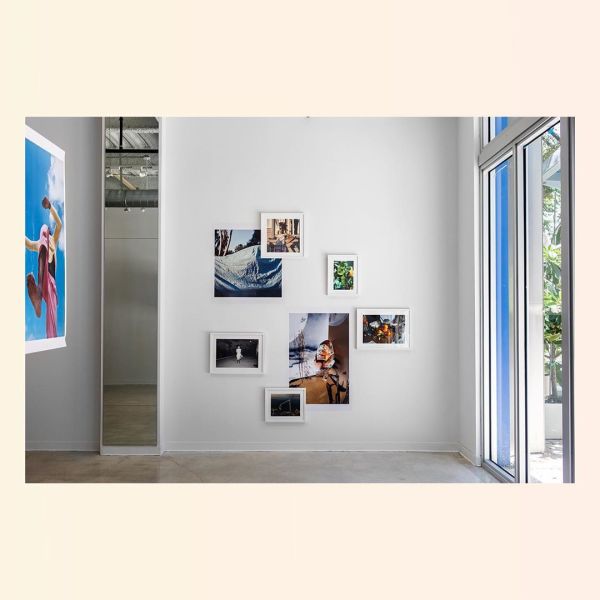
Reconstructing Identity is an exhibition exploring identity and diaspora through works drawn from practices of painting, photography, sculpture, and drawings, by artists of American, Cuban, Dominican, Haitian, and Jamaican cultures.
The exhibition is curated by Donnamarie Baptiste, and features works by Christopher Carter, Duwane Coates, Morel Doucet, Adler Guerrier, Rhea Leonard, Franciso Maso, T Elliott Mansa, Kandy Lopez-Moreno, Sharon Norwood, Onajide Shabaka, and Asser Saint Val.
Exhibition Dates: June 6 – 27, 2019; opening reception: 6 to 9 pm on June 6th, at Historic Ward Rooming House, 249 Northwest 9th Street, View Map .
This Miami MoCAAD (Miami Museum of Contemporary Art of the African Diaspora ) exhibit is made possible with the support of the Miami-Dade County Department of Cultural Affairs and the Cultural Affairs Council, the Miami-Dade County Mayor and Board of County Commissioners. Additional sponsors include Hampton Art Lovers, Southeast Overtown/Park West Community Redevelopment Agency and Sugarcane Magazine.

Born in Trinidad, on 20th of July 1948, passed away on 2nd of June, 2019.
Professeur de Littérature française à l’Université de New York, Michael Dash était connu pour ses nombreux travaux autour de l’œuvre et de la pensée d’Édouard Glissant.
mediapart.fr
Also, know for his scholarship on Caribbean literature and literary history.
“Haïti est la terre mère idéologique de la Caraïbe, le lieu où la lutte pour la liberté a produit une conscience collective, une nouvelle façon de penser la question raciale et de concevoir l’identité nationale”, a relevé l’universitaire Michael Dash. lemonde.fr (2009)
1930 – 2019, lemonde, ouest-france, Parasite.
On Questions politiques, France inter.
Mayor Cantrell Signs Sister City Agreement Between New Orleans and Cap-Haitien
nola.gov, May 21, 2019.
NEW ORLEANS – Mayor LaToya Cantrell today signed an agreement to become a “sister city” with Cap-Haitien, located on the north coast of Haiti.
“The origins of this relationship and shared history are born from the independence of Haiti and the doubling of the New Orleans population comprised of an exodus of free people of color, French colonists and slaves from Saint Domingue/Haiti upon defeat of the French rule, resulting in the Louisiana Purchase,” Mayor Cantrell said, in reading the agreement. “New Orleans is Haiti’s first Diaspora. New Orleans and Cap-Haitien (formerly Cap Francais) are twin sisters separated by birth. Today, many residents of New Orleans and the whole of Louisiana trace their ancestry to Cap-Haitien and other parts of Haiti. In recent years, many visits have been made and friendships built.”
“By this agreement,” Mayor Cantrell said in conclusion, “we celebrate a common heritage and seek to reinforce strong ties and secure a relationship that will persist into our futures.”
Mayor Cantrell signed the agreement along with Cap-Haitien Mayor Yverose Pierre, who spoke glowingly of the two cities’ relationship.
Other speakers included Alexis Neives, Commercial and Industrial Attaché for the U.S. Embassy in Haiti; and Vladimir Laborde of Haiti Inc.
Some of the features of the agreement include:
Academic cooperation between the respective cities’ universities and other educational institutions
Cooperation and exchange between local development agencies, chambers of commerce, and tourism departments
Opportunities for exchanges of art and cultural products between the cities’ respective museums and galleries, and other cultural institutions
Opportunities for municipal exchanges, including economic development in the areas of tourism, agriculture, infrastructure, city management and waste and water management – as well as emergency preparedness, disaster management and climate change.
Other honored guests included District B City Councilmember Jay H. Banks; Dr. Camellia Moses Okpodu, Dean of the College of Arts and Sciences, Xavier University; Lisa Alexis, Director of the City’s Office of Cultural Economy. Invited guests included Régine Chassagne, co-founder of the band Arcade Fire and co-founder of the Haitian-themed group Krewe of Kanaval.
From this interview of J. Michael Dash with The Public Archive (2012).
You were a close friend and translator of the late Edouard Glissant. What is his enduring legacy – as a person and as an artist?
The Public Archive | Published: March 4, 2012.
I remember reading recently that prophets are often defined by what they are not. I am not saying that Edouard Glissant was a prophet but he does represent an intellectual watershed in the Caribbean intellectual landscape. For the time being though, there is a tendency to regret what he was not. There has been a rash of criticism aimed at what critics call “the late Glissant” who is seen as blindly following Deleuzean nomadology in his apolitical celebration of global creolization. Even his defenders have tried to construct him as a “warrior of the imaginary” or pointed to the various political pamphlets written with Chamoiseau before his death. I think in both cases, critics are still haunted by the example of Frantz Fanon as a model for Caribbean writing. Glissant had never felt that literature should be put in the service of political causes – certainly not in a narrow, utilitarian way. He began writing at a time when a decolonized world heralded by politically committed writing was coming into being. These new nation states were flawed and there but there was no way of imagining alternatives. This was where literature as a new mode of cognition came in. As I have written elsewhere, Glissant, from the outset, proposed that writers and thinkers should be approached and frequented like towns. He said this about Faulkner and later about the figure of Toussaint Louverture. I think his thought should be approached in this way – an urban space of diversity, open to all and facilitating various intellectual itineraries. Perhaps, in accordance with the creole saying quoted in one of the epigraphs of Caribbean Discourse, “An neg se an siec” ( a black man is a century), the Glissantian century has only just begun
Figures of note as place, which can be “frequented like towns.” Psychogeography into poetry, paraontology, and imagined reality.
A related thought, not from the interview.
“L’imaginaire de mon lieu est relié à la réalité imaginable des lieux du monde, et tout inversement.”
Edouard Glissant