In the avoidance of that which we seek–– The sudden silence and reserve when near–– The eye that glistens with an unshed tear–– The joy that seems the counterpart of fear, As the alarmed heart leaps in the breast, And knows, and names, and greets its godlike guest–– Thus doth Love speak.
[…]
Glance strikes with glance, swift flashing high and higher, Like lightnings that precede the mighty storm; In the deep soulful stillness; in the warm, Impassioned tide that sweeps through throbbing veins, Between the shores of keen delights and pains;
“The “synchronic museum,” as he calls its new alternative, “would forego history in the name of a kind of intensity of experience, an aesthetic charge that is not so much temporal (historical) as it is now radically spatial.””
Ne fais jamais de peinture si tu veux vivre tranquille. Corot, to a friend
The most inviting landscape, where we say, “Here we may rest and make this landscape ours,” For him is apprehension. To convey A moment of its meaning calls on powers He sometimes doubts possessing. In his hand The palette with its colored spots and smears Seems to match nothing. On the easel’s bland And vacant canvas not a line appears To guide him. While we gaze and shift our eyes Accumulating all there is to see, His fuller sight begins to realize A world brought into being anxiously, Where structured shapes and contoured colors show A calmer scene than any we could know.
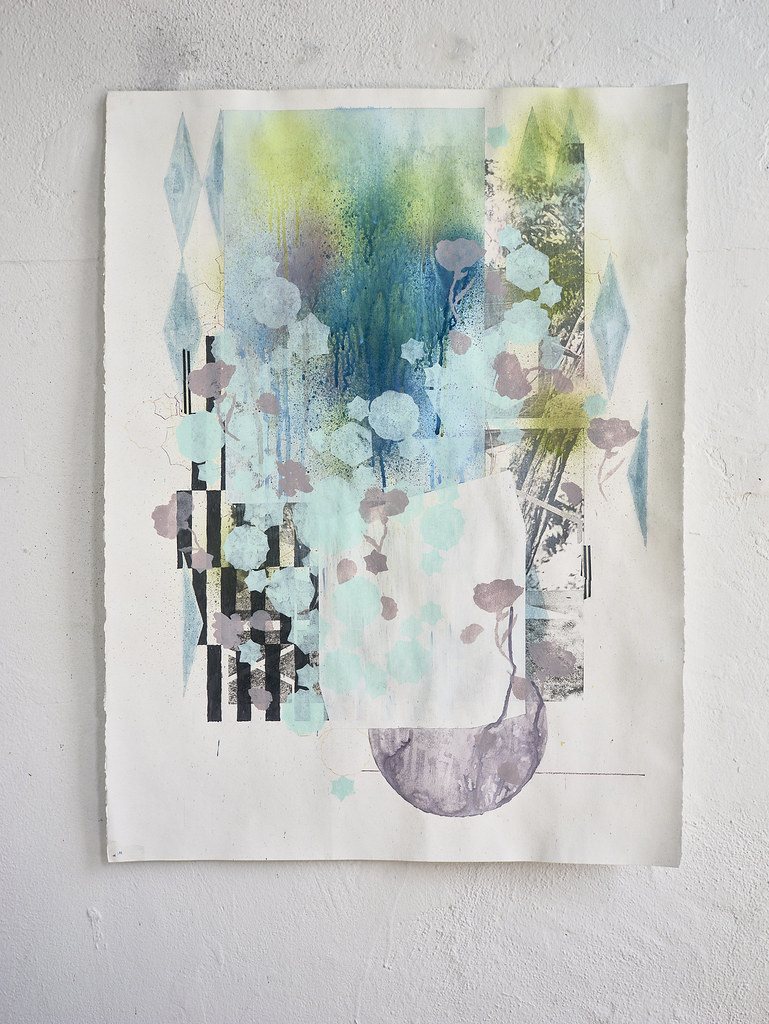
Untitled (sourced from the blck indices; formed and regulated; meandering and purposeful) 2026, Graphite, colored pencil, ink, acrylic, gesso, watercolor, gouache, tape, and solvent transfer on paper, 30” x 22.25”
How do you represent the divine and the central miracles of Christianity? Divine Presence explores this question through the captivating world of marble representations in Late Gothic and Early Renaissance art. (Hatje Cantz Verlag)
A creamy tear descended here when Cupid squeezed the teat of Venus. Dripping down the Milky Way it puddled beneath old oak, new pine. Love’s selfish thirst did pluck a cosmic note, set every entombed entangled bit of me in roots both new and old to singing. I was become in earth and by harmony a million bits of tongue and ear, sound funnels upwhorled in song conducting cones. Fresh music from old flesh corrected my (most melancholy) record of this last go round the planet. Now I was first things: elementals, vegetable and mineral in form, dust to kick it on the breeze, loam to feed old oak, new pine, Eros-greedy energy on hunt for nourishment, cream to suck, breast to squeeze.
The LRB Podcast, Poetry and the Turning World: Divorce (Hans Magnus Enzensberger’s ‘The Divorce’, Anne Carson’s The Beauty of a Husband , ‘The Mpemba Effect’, Isabelle Baafi)
The Beauty of the Husband: A Fictional Essay in 29 Tangos, Anne Carson.
“GG [Gary Garrels]: In 2008 we approached Kerry James Marshall about making new works for those walls. I had done a show here with Kerry James in the 1990s, so we already had a wonderful relationship of long standing. He decided he wanted to do something in dialogue with San Francisco’s venerable Mission mural tradition. He began discussions with Precita Eyes and came up with a plan to create views of the plantations of George Washington (Mount Vernon) and Thomas Jefferson (Monticello), but with black figures inserted. The intent was to point to the presence of black Americans on the plantations, while highlighting their absence from public history. The murals were fabulous.”
Spinning through space for eons, our earth—oceans, rivers, mountains, glaciers, tigers, parrots, redwoods— evolving wonders.
And our vast array, generations of humans—all shapes, colors, languages.
Can I be the only me?
Our earth: so much beauty, hate, goodness, greed.
“Study. Cool the climate,” advises my teacher. “Grow peace.”
    Can I be the only me,
                  become all my unique complexity?
The Thicket. 2024. Original Motion Picture Soundtrack, Ray Suen.
Jack & Lula, 4:42
Franz Schubert, Fantasie in F Minor, D. 940, 5:40 (Ray Suen · Thomas Nickell, Piano)
I will get me to the wood Where the gods walk garlanded in wisteria, By the silver-blue flood move others with ivory cars. There come forth many maidens to gather grapes for the leopards, my friend. For there are leopards drawing the cars.
I will walk in the glade, I will come out of the new thicket and accost the procession of maidens.
Droning a drowsy syncopated tune, Rocking back and forth to a mellow croon, I heard a Negro play. Down on Lenox Avenue the other night By the pale dull pallor of an old gas light He did a lazy sway. . . . He did a lazy sway. . . . To the tune o’ those Weary Blues. With his ebony hands on each ivory key He made that poor piano moan with melody. O Blues! Swaying to and fro on his rickety stool He played that sad raggy tune like a musical fool. Sweet Blues! Coming from a black man’s soul. O Blues! In a deep song voice with a melancholy tone I heard that Negro sing, that old piano moan— “Ain’t got nobody in all this world, Ain’t got nobody but ma self. I’s gwine to quit ma frownin’ And put ma troubles on the shelf.”
Thump, thump, thump, went his foot on the floor. He played a few chords then he sang some more— “I got the Weary Blues And I can’t be satisfied. Got the Weary Blues And can’t be satisfied— I ain’t happy no mo’ And I wish that I had died.” And far into the night he crooned that tune. The stars went out and so did the moon. The singer stopped playing and went to bed While the Weary Blues echoed through his head. He slept like a rock or a man that’s dead.