hafif

… 1975 Ink Drawings and a photo series titled Pomona Houses from 1970.

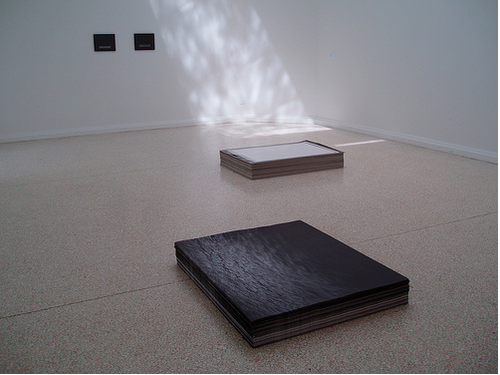
The Ink Drawings were painted using a practice developed during the making of the Pencil Drawings, 1972, always beginning in the upper left corner and finishing in the lower right. The support and medium change while the technique remains the same. Here the ink mixture is more or less diluted, with darker and lighter results. The technique is based on the idea that repetition will produce changing results; the titles of the drawings are the date of completion – a record of the day’s work.

Pomona Houses was shot in California in 1970 and published in 1972 in a book by Mother Lode Editions to accompany an exhibition of projected color slides of houses at the Ivan Karp Gallery in SoHo. The current show includes all forty-five photographs from the book framed and displayed at eye level in their original order.

Marcia Hafif lives between New York City and Laguna Beach, California. This fall her work was part of Pacific Standard Time’s Best Kept Secret, UCI and the Development of Contemporary Art in Southern California, 1964-1971 at the Laguna Art Museum, CA. Hafif’s Italian Paintings, 1961-1969, are on display at MAMCO in Geneva accompanied by a catalogue raisonne of Hafif’s sixties paintings.

For further information and images please contact the gallery at contact@npgallery.com.

Exhibition dates: February 23 – April 14, 2012

parents reward effective arguments

I like this story.

Allen says almost all parents and teenagers argue. But it’s the quality of the arguments that makes all the difference.

“We tell parents to think of those arguments not as nuisance but as a critical training ground,” he says. Such arguments, he says, are actually mini life lessons in how to disagree — a necessary skill later on in life with partners, friends and colleagues on the job.

Teens should be rewarded when arguing calmly and persuasively and not when they indulge in yelling, whining, threats or insults, he says.

In Allen’s study, 157 13-year-olds were videotaped describing their biggest disagreement with their parents. The most common arguments were over grades, chores, money and friends. The tape was then played for both parent and teen.

And so.

Effective arguing acted as something of an inoculation against negative peer pressure. Kids who felt confident to express themselves to their parents also felt confident being honest with their friends.