
Author: dig
-
ingrains floral embellishments
The purple stain, […] ingrains floral embellishments, inhabits longed-for gardens.

-
Room for/Souvenir
Locust Projects presents Locust Projects presents Room for the living/ Room for the dead, a new site-specific commissioned project by Miami-based artist T. Eliott Mansa.
The immersive and interactive installation merges the concept of Florida / Family rooms as a home’s casual, social hub for gathering, entertainment and play, with that of less-used living rooms that served as shrines for treasured family photos and heirlooms. Inspired/influenced by the artist’s friend and writer Noelle Barnes’ living room and the artist’s own memories of sunken living rooms of the 1970s, the artist considers the cultural phenomena of the living room as unlived, unoccupied, untouched spaces that children and guests were prohibited from using.

T. Eliott Mansa: Room for the living/Room for the dead 2022, installation view at Locust Projects. Photography by Zachary Balber. 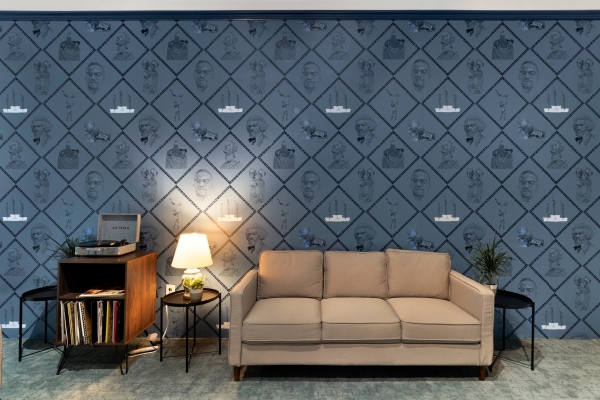
Kerry James Marshall’s exhibition, Mementos, at the Renaissance Society in 1998, is a requiem to the 60s, a decade synonymous with the Civil Rights Movement.
Conceived as an installation for the Renaissance Society, it features three new paintings, two sculptural components, a video projection and is replete with an angelic pantheon of African-American cultural and political figures who died between 1959 and 1979. Marshall uses the genre of history painting to reread the legacy of the Civil Rights Movement and the whole of African-American History in relation to a very complex present.
This exhibition traveled to Brooklyn Museum of Art; San Francisco Museum of Fine Art; Institute of Contemporary Art, Boston; Santa Monica Museum; and Boise At Museum.
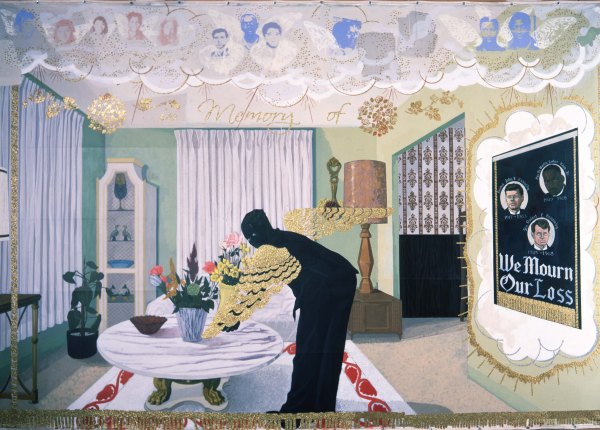
Kerry James Marshall, Souvenir I, 1997, acrylic with glitter on unstretched canvas, 9 x 13 feet, Courtesy of Museum of Contemporary Art, Chicago, Bernice and Kenneth Newberger Fund. Marshall modeled the settings of the Souvenir series after black middle class living rooms that have the shrine-like quality of Depression-proof interiors, as static and eternal as a plastic plant in a plastic pot. They are rooms where loved ones captured in the first generation of color photography yellow to the tick of a too accurate clock. There is a place for everything and everything is in its place, including the gaudy yet priceless souvenir cherished as a reminder of people and places that make up a life. It is where memorabilia from the births, graduations, weddings, anniversaries and funerals of a hundred distant relatives are preserved. For African Americans, all of whose lives were in some way affected by the struggle for equality, it is impossible to think of a room made claustrophobic with memories that does not double as a shrine to saints Kennedy and King.
Hamza Walker, To Fulfill these Rights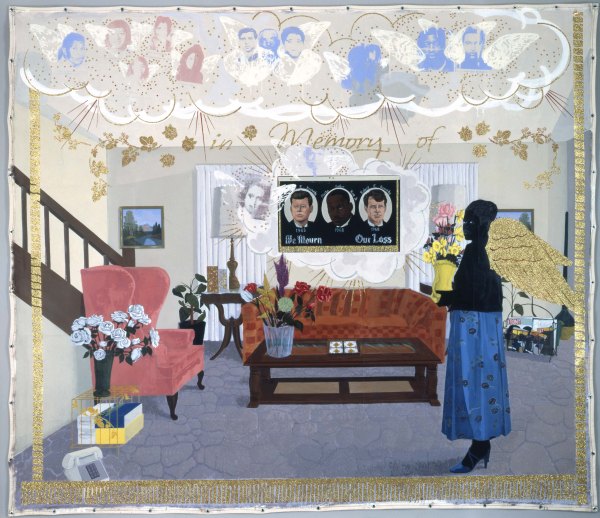
Kerry James Marshall, Souvenir II, 1997, Acrylic with glitter on unstretched canvas, 9 x 13 feet, Courtesy of Addison Gallery of Art, purchased as a gift of the Addison Advisory Council in honor of John (Jock) M. Reynold’s directorship, 1989-1998. 
Kerry James Marshall, Souvenir III, 1998, Acrylic with glitter on unstretched canvas, 9 x 13 feet, Courtesy of San Francisco Museum of Modern Art. 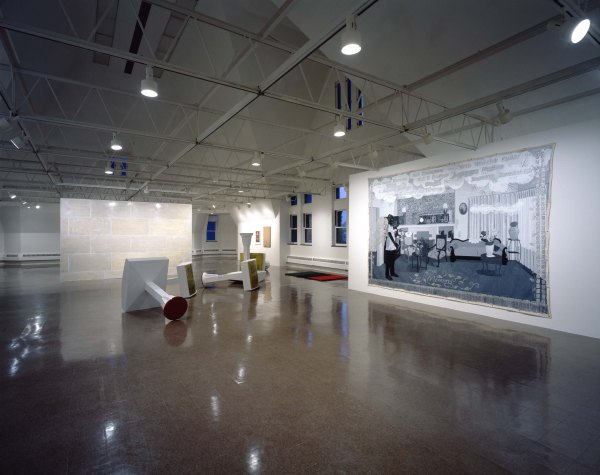
Kerry James Marshall, Souvenir IV, 1998, Acrylic with glitter on unstretched canvas, 9 x 13 feet, Courtesy of Whitney Museum of American Art. -
AG2023AG2023_1011608aa

“Don’t be afraid. This is the place. On the far side.” “I can’t see shit. I can hardly see you.” “Don’t see; feel,” she said. “You can feel your way, but hurry, hurry.
[…]
“This is the place. Where you can take a choice.”
Morrison, Tar Baby.Related : Place marked with an impulse, at an impasse.
-
AG2023_1012125a or calling away despair

darkness comes
suffering touches us
again and again
there is pain
there in the midst of
such harsh barrennessa cardinal […] calling away despair
-
AG2023_1012180a or the dark itself

Where would she go [… to ] a kind of purity of being and emptiness,
[I] can wander through worlds of light
less
of everything—wind& worry
-
Didion
Joan Didion: What She Means is an exhibition as portrait, a narration of the life of one artist by another. Organized by critically acclaimed writer and New Yorker contributor Hilton Als, the exhibition features approximately 50 artists ranging from Betye Saar to Vija Celmins, Felix Gonzalez-Torres, Maren Hassinger, Silke Otto-Knapp, John Koch, Ed Ruscha, Pat Steir, and many others. The more than 200 works include painting, ephemera, photography, sculpture, video, and footage from a number of the films for which Didion authored screenplays.
Opening less than a year after her death at age 87, and planned since 2019, Joan Didion: What She Means follows a meandering chronology that grapples with the simultaneously personal and distant evolution of Didion’s voice as a writer and pioneer of the “New Journalism.” The exhibition closely follows her life according to the places she called home and is laid out in chronological chapters—Holy Water: Sacramento, Berkeley (1934–1956); Goodbye to All That: New York (1956–1963); The White Album: California, Hawai‘i (1964–1988); and the final chapter, Sentimental Journeys: New York, Miami, San Salvador (1988–2021).
Joan Didion: What She Means is organized by Hilton Als in collaboration with Connie Butler, chief curator, and Ikechukwu Onyewuenyi, curatorial assistant.
EXHIBITION TOUR SCHEDULE
Hammer Museum, Los Angeles: October 11, 2022–February 19, 2023
Perez Art Museum, Miami: July 13, 2023–January 7, 2024Via Hammer Museum.
… it seemed to me that the exhibit homed in on what I consider to be Didion’s most overlooked works, including the book Where I Was From, her essay “Some Women,” and her groundbreaking investigation of the Central Park jogger trial, titled “New York: Sentimental Journeys.” “What She Means” provides a timely corrective to some of the backlash bashing of “Saint Joan,” as Daphne Merkin mockingly called her.
Evelyn McDonnell
JOAN DIDION: I am more attracted to the underside of the tapestry. I tend to always look for the wrong side, the bleak side.
ALS: I feel very defensive about her in that way. And it’s just – it’s bizarre to me that it’s even an issue, what she looks like. Please just read her.
ALS: No, because her work is alive. You have to think about it as an alive thing. So how could you respond by mummifying it? You could only respond by saying what was beautiful and what you’re responding to because you’re alive to the experience of reading her. No, she’s alive. Those words are alive.
The structure of the exhibition and the work it presents are ultimately difficult to follow, though pleasurable if one is a fan of both Didion and Als as thinkers; it leaves the viewer with little if any larger statement about the author’s life and impact that has not already been stated elsewhere in Als’s previous writings or in the 2017 documentary about Didion’s life, The Center Will Not Hold. However, the show does offer an important gesture; a nuanced, rich, and beautiful memorial for Didion.
Olivia Gauthier
“Deriving not only from the landscape but from the claiming of it, from the romance of emigration, the radical abandonment of established attachments, this imagination remains obdurately symbolic, tending to locate lessons in what the rest of the country perceives only as scenery.” Joan Didion.


